How to Quit Social Media
By KS
If you want to quit social media, the hardest part is usually not the account deletion itself. The hardest part is everything wrapped around it.
Social media is rarely just one thing. It is entertainment, habit, boredom relief, social signalling, contact maintenance, news consumption, validation, procrastination, and emotional noise all bundled together. That is why simply telling yourself to stop often fails.
This guide is a deeper answer to the question how to quit social media in a way that actually sticks.
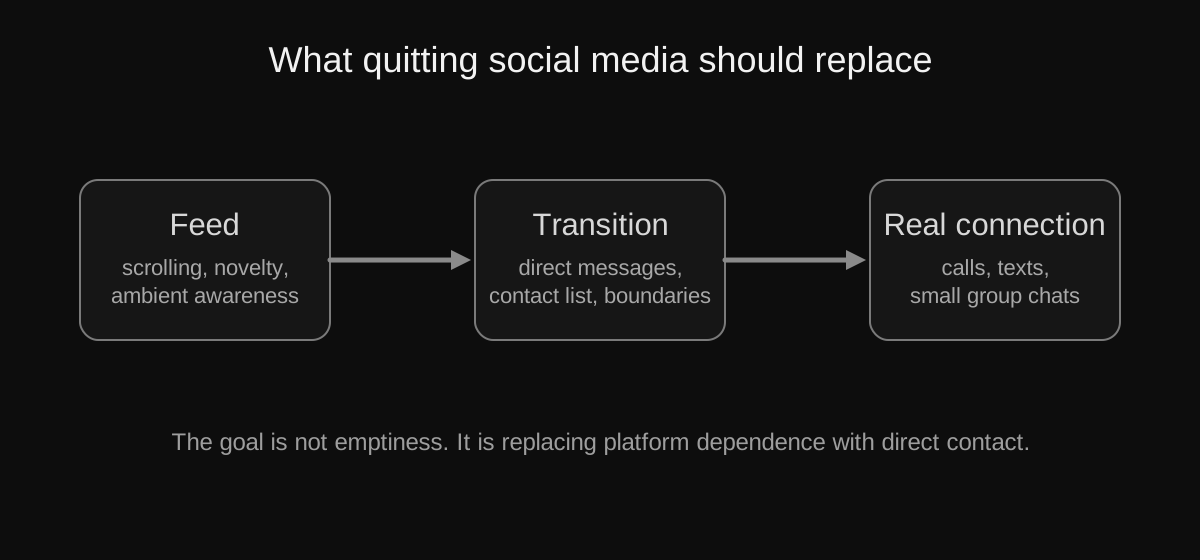
The real goal is not emptiness. It is replacing platform dependence with direct contact and lower-noise routines.
Why critics are so harsh on Meta and social platforms
This is not only about weak self-control. It is also about incentives.
In Meta’s 2024 annual filing, the company states that substantially all of its revenue comes from advertising. That matters because ad-driven platforms are structurally rewarded for holding attention, increasing engagement, and collecting signals that make targeting more precise.
Mark Zuckerberg said the business model out loud during his 2018 Senate testimony: “Senator, we run ads." (Senate testimony PDF) That line matters because it makes the incentive structure explicit. You are not mainly the customer. You are the source of attention and behavioural data that can be monetised.
The harm side is not hypothetical either. Internal Facebook research later surfaced in public reporting and congressional materials with the line: “We make body image issues worse for one in three teen girls." (House materials) You do not need to use the word evil to see the underlying pattern. Platforms can know a system is harmful in important ways and still keep optimising the same engagement machinery because the business rewards it.
Why quitting social media feels harder than it should
People often assume the difficulty means the platforms must still be serving an important purpose.
Sometimes they are. But a lot of the difficulty comes from something else: social media is designed to become automatic.
That means quitting can feel like removing:
- a daily reflex
- a source of stimulation
- a default response to boredom
- a background feeling of connection
- a place where you check how people are doing without directly speaking to them
You are not just removing an app. You are interrupting a habit architecture.
Step 1: figure out what social media is actually doing for you
Before you delete anything, get specific.
Ask yourself:
- which platforms do I actually use?
- what do I think I get from each one?
- what do I lose every time I use it?
The answers are often different by platform.
For example:
- Instagram may be mostly comparison, visuals, and compulsive checking
- X or similar platforms may be mostly outrage and news addiction
- TikTok may be mostly time loss and overstimulation
- Reddit may be a mix of useful information and bottomless distraction
You cannot build a good exit plan if you keep calling all of it “social media” as if it behaves the same way.
Step 2: decide whether you are quitting completely or changing the access pattern
There are usually three realistic approaches.
Option A: full quit
Delete the apps, stop using the platforms, and move important contacts elsewhere.
This works best when:
- your usage is compulsive
- moderation always collapses
- the platform causes obvious stress, envy, or time loss
Option B: desktop-only access
Remove the apps from your phone and allow access only on a laptop or desktop.
This works well when:
- the phone is the main problem
- you still need limited access for messages, events, or work
- you want friction without a total break
Option C: one narrow use case only
You keep a platform only for one purpose, such as direct messages or a business page, and deliberately stop using the feed.
This sounds simple, but it only works if you really maintain the boundary.
Full quit
Use this when moderation repeatedly collapses and the platform clearly makes life worse.
Desktop-only
Use this when the phone is the main trigger but you still need limited access for logistics or work.
One narrow use case
Use this only if you can actually keep the feed separate from the function you still need.
Step 3: preserve the relationships before removing the platform
One reason people return is that they confuse the loss of the platform with the loss of people.
Prevent that by moving important connections first.
Do this before a full quit:
- message the people you genuinely want to stay in touch with
- swap phone numbers or email addresses
- move key conversations to Signal, WhatsApp, or another direct channel
- create one small group chat if needed
Do not expect real relationships to survive on convenience alone. Give them a cleaner path.
Step 4: tell people where to find you
This matters more than people think.
If you are leaving a platform, post one clear note before you go.
Something simple is enough:
- I am spending less time here
- you can text or email me if you want to reach me
- here is the best way to contact me
That reduces both confusion and the fear that quitting means disappearing.
Step 5: remove the app before you remove the account
If you are unsure, try this transition first:
- delete the app from your phone
- stay off for two weeks
- keep a note of what you genuinely missed
- separate real needs from phantom habits
A lot of people discover they mostly miss the reflex, not the value.
Step 6: expect withdrawal from stimulation, not just from connection
This is the part many people misread.
When you quit social media, you are not only losing “contact.” You are also losing:
- novelty
- speed
- outrage
- humour on demand
- a constant drip of information
- the sense that something is always happening
That can feel like loneliness even when it is really overstimulation withdrawal.
Knowing that helps you avoid panicking and reinstalling too fast.
Step 7: replace the habit loop with something low-friction
You do not beat a feed with abstract good intentions. You beat it with a replacement that is easier to reach than the old habit.
Good replacements include:
- texting one real person directly
- reading a book that stays nearby
- going for a short walk
- journaling or note-taking
- an offline hobby that starts quickly
- longer-form reading on a laptop instead of feed-scrolling on a phone
The more friction a healthy alternative has, the more likely you are to drift back to the feed.
Step 8: reduce your exposure to “just checking” moments
A lot of social media use is not planned. It happens during micro-gaps.
Examples:
- waiting in line
- waking up
- going to bed
- sitting on the toilet
- walking somewhere familiar
- feeling slightly uncomfortable or bored
Those are the moments to target.
Helpful changes:
- keep your phone out of reach in the bedroom
- remove browsers from the home screen if social media lives there too
- use app blockers or downtime
- keep one offline fallback nearby, like a notebook or paperback
Step 9: if you need social media for work, separate work from habit
This is a real issue for some people.
If you genuinely need access for work, do not let “work” become a permanent excuse for unlimited exposure.
Try:
- desktop-only access
- a fixed posting window
- separate work and personal accounts
- scheduling content instead of hanging around on the platform
- checking comments or messages at one defined time instead of all day
The rule should be: use the tool for the work, do not stay for the feed.
Step 10: know what relapse usually looks like
Most relapse is not dramatic. It is quiet.
It usually sounds like:
- I’ll just reinstall it for messages
- I’ll only check once a day
- I need it for one event
- I’ve been good lately, so I can handle it now
Sometimes those are true. Often they are the beginning of the same loop again.
That is why boundaries matter more than mood.
Step 11: decide what success actually looks like
Success does not have to mean becoming permanently unreachable.
For some people, success is full deletion.
For others, success is:
- no social media on the phone
- no doomscrolling in bed
- one weekly desktop check only
- direct contact replacing passive lurking
Pick the version that gives you back attention, privacy, and calm.
The privacy side of quitting social media
Quitting social media is not only about time. It is also about data.
Feeds learn from:
- what you stop on
- what you click
- what you like
- what you ignore
- how long you watch
- which topics trigger repeat engagement
That means social media is not just a time sink. It is one of the densest behavioural profiling systems in modern life.
That is why quitting or sharply reducing it helps both screen time and privacy at the same time.
A practical 14-day quit plan
If you want a concrete starting point, use this:
Day 1 to 2
- identify your worst platform
- remove it from your home screen or delete the app
- write down the people you actually want to keep in touch with
Day 3 to 5
- move key contacts to direct channels
- post a simple contact-update message if needed
- turn off remaining social notifications
Day 6 to 9
- keep a note of when you want to check the app
- write what triggered it: boredom, anxiety, loneliness, habit, procrastination
- replace the check with one simpler action
Day 10 to 14
- decide whether desktop-only is enough or whether you need a full quit
- remove access routes that are keeping the habit alive
- make one replacement routine permanent
Frequently asked questions about quitting social media
Is it better to delete accounts or just remove apps?
For many people, removing the apps is the best first step. It creates distance without forcing a dramatic all-or-nothing move on day one.
What if I lose touch with people?
Real relationships usually survive a platform change if you replace the contact path intentionally. Passive awareness is not the same thing as closeness.
What if I keep coming back?
Then your boundaries are probably too soft. Add friction. Use desktop-only access. Delete the apps again. Reduce the number of situations where checking is even possible.
Is Reddit social media?
Functionally, often yes. If it behaves like a feed, creates time loss, and keeps you in a loop of endless input, it deserves the same scrutiny.
The deeper goal
The real goal is not moral purity. It is getting your attention back.
When you quit or sharply reduce social media, you often notice more than extra time. You notice less noise, less comparison, less agitation, and fewer invisible hooks pulling at your mind all day.
If you want the screen-time side of this problem, read How to Reduce Screen Time. If you want the privacy side, continue with How to Reduce Your Digital Footprint Step by Step.